How it works
How to sell a Pokémon card collection, step by step
You do not have to sort a collection before you sell it. Call, tell us roughly what is there, and you get a price on that call, before anything is packed or posted. If you take it, we send what you need to ship and we pay the shipping.
Call, or ask us to call you
A person who knows cards picks up, not an operator and not a form that disappears into a queue. If you would rather we rang you, the callback form asks for a phone number, and requests are answered within the hour.
Tell us what you have, and get the number on that call
Sets, rough counts, anything graded, anything you think is good. You do not need the vocabulary. If you can read us the set name and the little number at the bottom of a card, that is enough to identify almost anything; if you cannot, describe it and we will work it out together. The price is worked out while you are on the phone, so you hang up knowing the figure rather than waiting on an email.
If the number works, the shipping is ours
We send what you need to ship the collection, and the postage is paid by us. You pack the box; there is nothing to buy and nothing to arrange yourself.
As described means paid the number you were quoted
If the cards are as you described them, there is no renegotiation and no quiet deduction. Every offer is filmed, so there is never an argument about what arrived. If something genuinely is not as described, we re-quote it and you decide, and the section below says exactly what happens then.
Before you ring
How to spot what is worth a call in a binder
You do not have to sort a collection before you sell it, but five things are worth pulling out first, because they are where most of the money in an old binder tends to be.
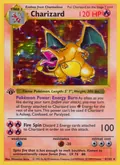
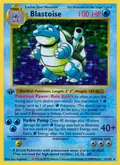
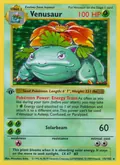
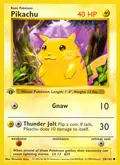
- A 1st Edition stamp. A small black circle with a “1” and the word “Edition”, just below the left side of the picture, marks a first print run of the early sets. The same card without it is a different, cheaper card, so mention it on the call. The Charizard, Blastoise and Venusaur pages show the Base Set versions.
- Shadowless Base Set cards. The earliest Base Set prints have no drop shadow along the right-hand edge of the picture box, so the frame looks flat. They trade as their own printing, apart from the later unlimited run.
- Holos. A rare whose picture is foil, shiny under a light, is the first thing to set aside in any early set. The Umbreon and Lugia pages show the Neo-era holos people find in old binders.
- The set symbol. Base Set cards carry no set symbol at all, which is one quick way to tell them from the sets that followed, each of which added its own small symbol. The 15 English sets from Base Set (January 1999) to Skyridge (May 2003) are what most people mean by vintage.
- Graded slabs. A card sealed in a hard plastic case with a grade on the label has already been graded. Read us what the label says; our card values pages show what each grade of a card sells for, from raw up.
Bulk
Is a bulk collection worth anything?
A box of ordinary commons, on its own, is not worth much. A published bulk buylist gives a sense of the floor: on October 16, 2026, Meta TCG’s bulk buylist listed $0.02 a card for commons and uncommons and $0.035 for a holo rare, while EX, V and GX cards were $0.50 each.
What changes the answer is what is mixed in. A vintage holo, an ex card, a 1st Edition stamp or a slab hiding in a shoebox is priced one card at a time, not by the thousand, and those are the cards that make a bulk box worth the call. Tell us roughly what is in it and we will say on the call whether there is anything worth shipping. For per-card rates from several published buylists and a list of what to pull out first, see selling bulk Pokémon cards.
The re-quote
If what arrives is different
Sometimes a card is not what either of us thought: a crease that did not show over the phone, a slab whose label does not match the card inside. When that happens we re-quote it and the decision is yours. Take the new number, or say no and we send the whole lot back to you at our cost. Turning down a re-quote never costs you the postage.
More on how that works, and on everything else that protects you, is on your protections when you mail cards.
On the call
Four things worth having in front of you.
The cards themselves
- Being able to look at them while we talk is worth more than any list.
- The set name sits beside the little symbol; the number is at the bottom.
- If a card is in a plastic slab, the grading company and grade are printed on the label.
A rough sense of scale
- Roughly how many cards, and roughly which years.
- Whether anything is still sealed.
- Which ones you already suspect are the good ones — you are usually right.
I have no idea what any of it is. Is that a problem?
No. Describing what you can see is enough to start: the artwork, roughly how old it looks, whether the picture is shiny. Working out what a card is happens to be the easy half of this job, and the card values pages help if you want a head start.
Do I have to sell the whole collection?
Tell us on the call what you want to keep. The quote is for whatever you actually want to sell, and childhood favourites staying in the box is a normal thing to want.
What if I change my mind after the quote?
Before you ship, nothing happens: the quote on the call is not a commitment. Once the cards are with us, a re-quote you turn down sends them back at our expense rather than yours.